Nothing to lose but your lanyards! – reflections on unionising at an art gallery.
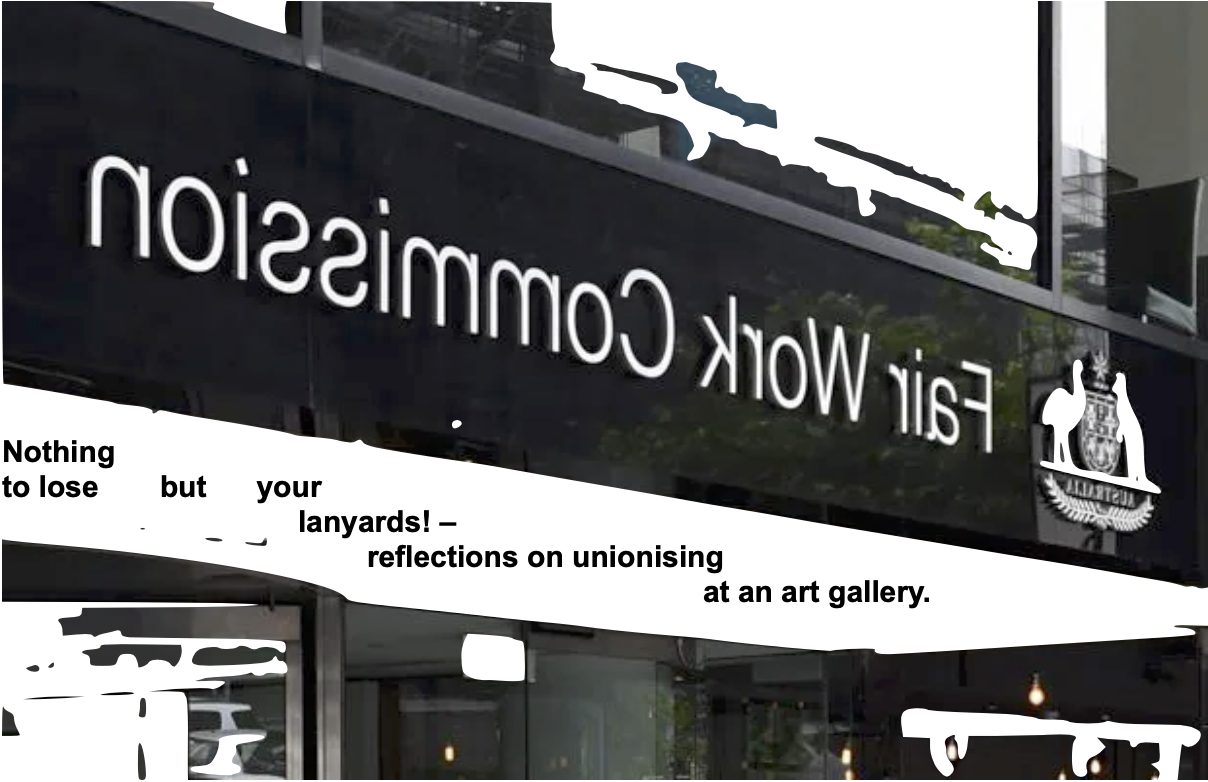
Fair Work Commission, Digitally Edited Photograph, 2026.
Nothing to lose but your lanyards! – reflections on unionising at an art gallery.
Emily Hubbard
It’s been ages since I first worked in the arts but it’s something that I often reflect on. In recent times, it has become apparent how cultural institutions and creative festivals' main objective is not to benefit the broader public to engage, learn and be creative, but rather, are operated for the benefit of the rich and powerful. For artists and arts workers, it can feel like a lonely and hopeless industry where you just keep gritting your teeth, biting your tongue and showing up to keep the often questionable shows on the road. And while my experience of working in the arts was defined by juggling casual employment, navigating nepotism and pouring free drinks at VIP opening events, the lessons I learnt from the industry are as inspiring as they are deflating.
It was around 2017 when I got the opportunity to volunteer for a prestigious art gallery. Donating your time to a gallery goes both ways: you want to be there for free and the gallery directors and board members certainly want you to be there for free, too. To be afforded this opportunity, I firstly had to pass the test of a group interview during which they kept emphasising that only twenty volunteer positions were available and over seventy people had applied, so congratulations on making it to this stage! If you were accepted for a volunteer position, you would then be emailed your rostered shifts and informed of the perks: 5% off at the gallery’s bookshop, a free coffee during your volunteer shift and an exclusive invitation to the staff-only exhibition walkthroughs prior to the exhibitions being opened to the public.
After two years of volunteering (alongside working casual jobs and studying), I remember being asked by a Gallery Attendant (abbreviated to ‘GA’) why I hadn’t been offered a paid job yet. I always felt the GAs were the luckiest people in the world because they somehow managed to get paid while doing the same job that I did for free. It was even a mystery how anyone could get that paid position as it was never advertised publicly but only offered through internal emails.
I kept turning up to my volunteer shifts then eventually, the Front of House Manager offered me a paid GA position. I was so proud to accept it, even if what I was actually offered was a position of a ‘Back-up GA’. This meant that I was not on the roster, but a ghost casual to be called upon to fill gaps left by the unpaid absences of others. As such, some weeks I was rostered on for volunteer shifts as well as paid ‘back up’ shifts. It felt wrong to be paid in lattes on some days and to receive a wage on others – while doing essentially the same job.
TERMS OF EMPLOYMENT
1. Employment
1.1 You will be employed on a casual basis according to the needs of the Employer from time to time in the position of Gallery Attendant. As a casual employee, there is no guarantee of any minimum number of shifts or ongoing employment. The terms of this contract shall apply on each and every occasion that you are engaged by the Employer to perform services, regardless of your position or the duties you perform, unless agreed otherwise in writing.
1.2 You agree that:
a) an offer of employment is made by the Employer to you on the basis that the Employer makes no firm advance commitment that the work will continue indefinitely with an agreed pattern of work;
b) you accept the offer on that basis;
…
In Australia, casual employment is essentially a zero hour employment contract where your boss rosters you as needed for the day or week. It means every day of work is just like your first and last shift. Precarity tends to be presented as a benefit offered to employees in the cultural sector as it affords them the supposed ability to choose when to work to complement their artistic careers. In practice, you are forced to compete with colleagues for shifts. This state of constant precarity and competition with your peers leads to the constant necessity to put yourself and your interests first above others. This individualistic logic isn't just limited to the workplace – it extends across the art industry as artists must adopt this mindset when applying for funding, open calls and residencies. Only after working in the arts did I start drawing connections between individualism and precarious employment in this sector.
I was surprised to learn that many of my co-workers were quite jaded about art in general and their jobs in particular. After a while I realised that the industry isn’t as wholesome, communal or subversive as it initially appeared. Although being paid to chat to the public about art is invaluable, pessimism can set in pretty quickly when you’re spending so much time in galleries. My experience taught me that some punters, artists and arts workers are lovely and make you want to cry, while others aren’t so lovely and make you want to cry for the opposite reason.
I don’t think I was overly naive to begin with but I gradually developed a pretty nihilistic view of working in the arts. Outside of work, I noticed how artist-run initiatives mimicked the same professionalism, corporate structures and net/nep-working conventions as major institutions. Much of the same money sources are shared across the arts coming from philanthropy and corporate sponsors. I began to share the jaded outlook of my co-workers and would often end up in discussions on-shift about how individuals within this industry could counter this structure of money, toxicity and gatekeeping. Did the answer involve further embracing nihilism, cynicism and anti-social everything-is-fucked-ism? Or maybe developing critical interventions with crucial bibliographies and word soups of affects, rhizomes and oddly placed brack(e)ts? There had to be something else…
CONCILIATION PRIZES
We eventually grew tired of just complaining about our employment conditions and realised that we could actually win some real gains if we all joined the union. We did our research and worked out that as union members we could negotiate our own collective conditions beyond the bare minimums that we received under the Amusement, Events and Recreation Award. It took a lot of back-and-forth emails to management before we were able to start bargaining for an enterprise bargaining agreement (EBA) at the gallery. Since management was opposed to this, the union had to threaten to apply to the Fair Work Commission (FWC) for a ‘majority support determination’, which would legally order them to negotiate. Management then agreed to start bargaining. The terms of the EBA would only cover the unionised staff at the gallery, which included the majority of front of house.
Bargaining firstly involved compiling a log of claims with all union members, and then negotiating it against the management’s counter offer until we reached an agreement or stalemate. This process had to be legally completed to a 'reasonable' standard before we could consider a vote to strike. It took about eight months of reasonable discussion before bargaining had legally reached an impasse and we had the option to conduct a vote among workers to decide whether we wanted to lawfully go on strike. Although the workers were keen and voted up the strike, some new industrial laws had been recently introduced by the Albanese government and we were obliged to go to compulsory conciliation sessions at the Fair Work Commission.
The conciliation involved gallery management and the union sitting down with a Commissioner and going through each clause in the proposed EBA. The Commissioner split his time between our room and management's room, convincing us through his assumed 'reasonableness' that we were asking for too much. At times we conceded, at times we argued, sometimes we bit our tongues.
We were learning a lot about industrial relations while going through all of this, along with the history of the union movement in Australia. Ever since Australia’s Federation, one of the roles of the Australian state has been to maintain industrial peace between employees and employers. Britain’s bloody colonial mission to install capitalism on stolen land had almost collapsed during the industrial disputes in the 1890s. The sheep shearers strike of 1891 led to the use of military force to crush the unions at the time. This also directly influenced the federating of the separate colonies into a nation-state to provide a liberal, cure-all solution to the potential risk of class-war.
More recently, the role of unions in Australia was heavily reduced in the 1980s with Hawke and Keating’s regressive reforms, which paved the way for more intense attacks on workers’ rights and unionisation from the Howard government in the 1990s and Rudd’s ‘Fair Work’ innovations in the 2000s. EBAs weren’t always a thing; there used to be just industry-wide awards, but EBAs limit workplace improvements and strikes to single workplaces rather than to entire industries. Learning some of the history of industrial reforms and class struggle in Australia helped to put our frustrations with the legal system into perspective. In practice, bargaining taught us how much of the employers’ power we were up against in the court, and also how much was behind us in the union movement.
WE DIDN’T STRIKE WHEN PROVOKED
We ended up getting an EBA with a bunch of improved conditions. This was a huge win, but I felt like our struggle ended due to our exhaustion from the lengthy bargaining process. We didn’t go on strike, which now feels like the biggest regret from that struggle. I reckon there were two main reasons for not doing this. Firstly, doubt — we questioned ourselves, thinking: were we going too hard, and was it all worthwhile? Second, fatigue — management was really good at delaying meetings and it was hard to maintain momentum among union members.
Looking back on it all, I think these two reasons are fair. We were pushing for a lot in what is ultimately a very unorganised and union-allergic industry. It was a huge effort by all the union members for sticking it out and not backing down. It is wild how Australia’s system of industrial relations essentially operates as a machine that prevents strikes happening at all. Australia’s strike laws are still among the most restrictive in the world. In essence, the right to strike allows working people to lawfully withhold their labour from their employer in order to advance their interests. For workers in Australia, this right is not unconditional. Workers and their unions need to jump through a lot of hoops before the possibility of taking “protected industrial action” becomes a real possibility. Without the right to strike, our power was severely limited during our bargaining for the gallery EBA.
HERE TO STAY!
Union membership in Australia is at an all-time low. Despite this, union battles still happen every day, whether it is workers on a construction site, in a retail store or at an art gallery. The wins of each of these struggles are always to be celebrated and protected by workers.
It’s difficult to be positive about the future of the arts. Cultural institutions survive on government grants and are guided by conservative, pro-business boards, which limits the ability for these places to genuinely be dedicated spaces for experimentation, critique and expression. Working in the arts is also unsustainable for most people due to the working conditions offered. As the arts employ people via volunteering, ‘back-up’ casual positions, or fixed-term contracts that are advertised with the generous inclusion of bare minimum employment entitlements, the blatant exploitation of our love for the arts is used and abused by cultural institutions that ultimately operate for the wealthy and financially stable.
While the connection between unionism and the arts feels difficult to make clear, I think the dislocation of the cultural industry’s workforce primes arts workers and working artists to be nihilistic, disenfranchised and isolated. At the conclusion of bargaining at the gallery, we gained so many material wins which would have otherwise never been given to us. It was something real that could have only been initiated and actioned by everyday arts workers doing something as basic as joining their industry union together and pushing for more.
Emily Hubbard is an artist who is interested in exploring the relationship between art and popular culture. Emily primarily draws inspiration from her day-to-day life as a services worker within galleries, museums and community spaces, as she strives to produce art that counters individualism and builds solidarity.
This project is presented in partnership with un. Projects