Sick Witch Recites The Greater Mandala of Uselessness
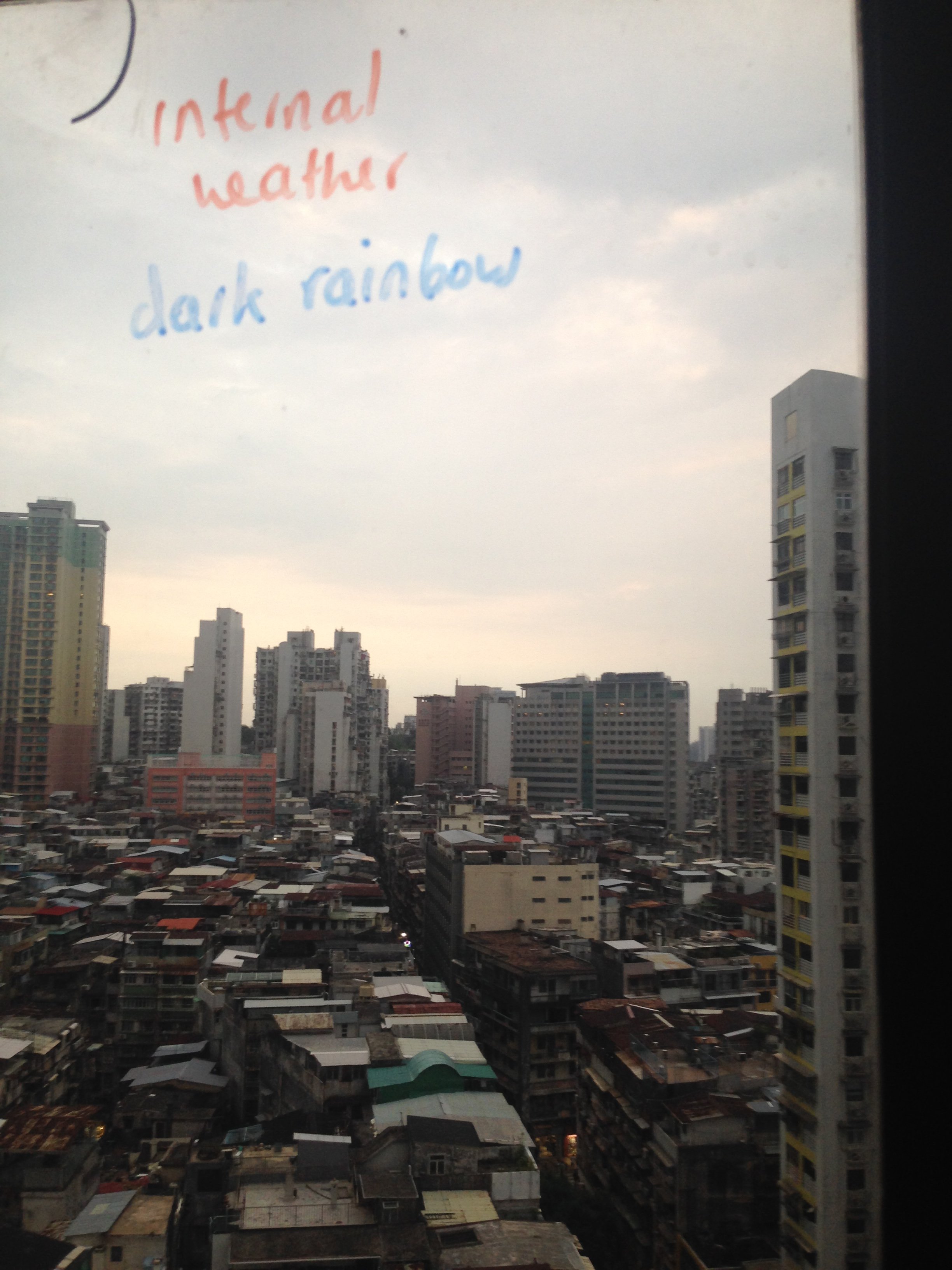
Sick Witch Recites The Greater Mandala of Uselessness
Amaara Raheem
Gunyang / Midsummer
This is a spell to reverse the night.
This is a spell to enter the archive.
This is a spell to tell the story – again.
On the longest day of the year, when the Sun King was at the end of his youth, I went to the Imaging Service Centre in Camberwell, sat by myself in a small room that could easily be mistaken for a cupboard and waited to be called for an ultrasound. I took off my yellow corduroy skirt and undid the shell buttons of my brown silk shirt. I put on the white hospital gown they gave me but I kept wearing my gold sandals. I looked in the mirror and thought how healthy I glowed on this midsummer day. My skin was clear, my eyes were bright and my hair shimmered like a soft storm cloud. I nodded and smiled at the woman in the looking glass. She nodded and smiled back.
I began reading a small hardbound book of art essays produced for the Venice International Performance Art Week 2012 titled Hybrid Body – Poetic Body. It was wonderful to read Bojana Kunst’s text, Impossible Becomes Possible, while waiting in a small cupboard. It was wonderful to read about contemporary art experiments on the transformation of the human body — its complex relations with manipulation and technology — to consider the body as a machine, to think about the 'use-less-ness' of the human body, our longing for an impossible body, an artificial body. It was wonderful to mull over her thoughts on the performing body and the 'bargain' we make in the theatre with 'presence' over 'imperfection'. It was wonderful to muse on biological regeneration before I was called into Room No. 5.
'Everything ok?' I asked hopefully.
'Very suspicious,' said the radiologist.
I soon learned that a malignant tumour was growing in my breast, two and a half centimetres along from the nipple, at ten o’clock. That it had advanced into the lymph nodes under my arm and in my collarbone drew a flock of medical specialists flying to my case, like birds of omen. Together, they recommended six months of chemotherapy to reduce the tumour.
Surgery would come after, they said. Then six months of radiotherapy.
'We’ll hit you hard,' said the oncologist.
'It will hurt,' said the surgeon.
Then the nurse read me a list of side effects which may or may not be temporary:
Fatigue, burning of the skin, changes in appetite, vomiting, diarrhoea, hair loss, mouth sores, shortness of breath, swelling of limbs due to damage of the lymph, thinking and memory changes, sexuality, intimacy and fertility loss, unpleasant body odour, ringing in the ears, damage to the heart, lungs, kidneys, nerve endings or reproductive organs, increased anxiety, and occasionally — many years after chemotherapy — a new, unrelated cancer might develop.
So, I signed the form agreeing to all this, to save my one and precious life.
In the weeks that followed, I searched for a language more sympathetic than scans. A language, or lineage, that could hold everything I now contained – ‘death, time, light patterns of a millennia opening in my gut; – and so that is how, and why, she arrived.
The figure of the witch — as a woman who matters politically — came to me through the writings of Italian-American Marxist-Feminist scholar Silvia Federici, the year I was treated for breast cancer. Federici argues that the witch hunts of the fifteenth to seventeenth centuries were not irrational superstition but a strategic, state-backed campaign that laid foundations for modern capitalism.
In Witch (BBC Radio), India Raknes traces how this figure is made monstrous, outlawed, disposable, and at the same time fetishised, desired — a contradiction that sustains both persecution and fascination:
The witch is the enemy of God, is the enemy of the people, is the enemy of man, is the enemy of the state.
The witch drives away all pain and fear. She brings our desires ever near.
Hestia Peppe, a researcher in divination, makes an important distinction between two approaches to magic:
““Witches” magic is the wisdom and practice of oppressed peoples; the occult is the organized keeping of secrets by those in power. … It is naïve to simplify the politics of magic and overlook its use by fascists and white supremacists”, writes Peppe.
& The visibility of witchcraft today has its roots in long histories of oppression and instability.
I believe Korean-American artist and musician Johanna Hedva would agree with this. Hedva says their practice cooks magic, necromancy, and divination together with mystical states of fury, ecstasy, solidarity and disintegration. They collect knives. They garden. They are devoted to deviant forms of knowledge and to doom as a liberatory condition. There is always the body, they say. ‘Its radical permeability and dependency — but the task is how to eclipse it, nebulize it, or cope when that inevitably fails.’
Hedva has a chronic illness. That is, a disease that comes from the Greek chronos: time. In Hedva’s case, a lifetime. There is no cure.
Hedva started writing Sick Woman Theory 'as a way to survive a reality that I find unbearable but which nevertheless must be borne. I wrote to bear witness to a self that does not feel like it can possibly be ‘mine.’ I wrote as a way to find my way into a world in which I don’t know how to belong, and yet here I am.'
If Federici ties the Witch to colonial expropriation — showing how everything once held in common, from water to seeds to our genetic code, became privatised in new rounds of enclosure tied to the subjugation of women, the transatlantic slave trade and the colonisation of the Americas — then Hedva binds this framework to historical, social, physical and planetary illness as magic.
Waring / Samhain
This is a spell to quench the fire in your bones.
This is a spell for what you must learn about grief.
This is a spell for what you must learn about peacefulness,
a peacefulness so big it dazes you.
Lying on the shining hardwood floor of a dance studio in West Footscray, I remembered that before I was me, I had been a single cell, pulsating in amniotic fluid. It was a perfect equinox day, when the superb lyrebirds performed their magnificent courtship dances and the mist rolled in over the cerulean sky. Lying there, I felt all six of my limbs — two arms, two legs, mouth, tail — and I moved from any one of these limbs, noticing how that reorganised my patterns of motion, and all the while, I was aware that the malignant tumour inside my breast was dividing and spreading fast. Faster.
The chemotherapy had numbed the ends of my fingers. Cast into the sea, I was all shadow and wave. I had not lost my appetite — not for sweet mouthfuls of love. But something else was there now. It hauled me through the air. The skin inside my nose thickened with blood. My toenails blackened and began to lift, but still I could walk for an hour in the park, become cellular, and peel an orange.
Lying there, I was reminded that Susan Sontag wrote Illness as Metaphor in 1978 while being treated for breast cancer. At the time, in the popular imagination, cancer was abominable, repugnant to the senses, a spectacularly wretched death. Trends in alternative cancer treatment and psychotherapy then suggested a 'cancer personality,' and urged that patients had brought cancer upon themselves by having a resigned, repressed, inhibited personality.
In response to metaphors such as this, Sontag refutes:
“All this lying to and about cancer patients is a measure of how much harder it has become in advanced industrial societies to come to terms with death. … Cancer, as a disease that can strike anywhere, is a disease of the body. Far from revealing anything spiritual, it reveals that the body is, all too woefully, just the body.”
But is the body just the body?
Or is the body a site of collective organisation, extending the logic of metaphysical thinking into its bones and flesh?
Or is the body a spell, open to others?
Alongside the chemotherapy I received acupuncture. The acupuncturist slapped my hand each week and shouted, 'what energy!' Sometimes I wished I were already dead and at other times I felt so grateful that I had a chance for another field of summer. I cried and cried but not too much. I didn’t want to melt my silver.
A port — the size of a small computer mouse — had been inserted into my chest. A wire ran through my jugular and rested just above my heart. Entangled with machines, I had become a system without secrets. Here, a fork was marked, altering the course of paths.
Look! She is walking at night. Beware! Beware! / Her flashing eyes, her floating hair!- Somewhere, a bell tolls. The sick witch sits beside me on the easy chair and presses her long thin bony hand on the white blood cells growing in my marrow sending shooting pains to the tip of my spine. Her head is bent, her eyes downcast. She wears a dark red cloak like poisoned wine or spilled blood. Look!
The sick witch, according to Hedva, is an identity. They are also a body that has been denied the 'cruelly optimistic promise of the white, straight, healthy, neurotypical, upper and middle class, cis- and able bodied person who makes their home in a wealthy country, has never not had health insurance, and whose importance to society is everywhere recognised and made explicit by that society, whose importance and care dominates that society, at the expense of everyone else.'
For me, the sick witch is all the above, and something else. She is the Witness, the Wanderer – like Melmoth: a figure who sees despair — yours and mine — when all the other witnesses are gone. Lying in this bed, with these hands turned up, utterly empty, I am not alone. Her shadow is here, like the sphinx; her presence signalled in the sudden scent of lilies.
When she speaks, her voice is soft like gravel, or swamp-dark honey:
This is a spell for 'it’s going to hurt.'
This is a spell for 'I can’t.'
This is a spell for the 30 cm nail driving into your breast.
This is a spell to correspond with your tumour, breath by breath.
This is a lantern to keep you from dying,
From what Sylvia Plath once called that comes from ‘a country as far away as health’
This is a spell for the blade in your mouth.
This is a spell for an alternative to capitalist society.
This is a spell for standing centre-stage, against history.
This is a spell for cancer, the sacred scarab, symbol of protection.
This is a spell for hospital green, lit red and white by wall lights, ceiling lights, exit signs.
This is a spell for the common beetle who rolls her dung in a ball up the hill.
This is a spell against ongoing attacks on women, and the return of witch-hunting.
This is a spell for falling through space.
This is a spell for safe passage into life–death–life.
This is a spell for no longer being simply beneath the night sky, but also above it.
This is a spell for turning left instead of right.
This is a spell for a new kind of language that comes from the Kingdom of the Sick.:
crystals that scatter
light beyond the beam
Guling / Beltane
When I woke, many moons later, the silver wattle was flowering and she was gone.
I sat up in bed and took my first sip of the sun. I turned on the radio.
'Brave soul,' said the radio.
'Beauty,' said the radio.
'It had to be like this,' said the radio.
Bibliography
Federici, Silvia. Caliban and the Witch: Women, the Body and Primitive Accumulation. New York: Autonomedia, 2004.
Hedva, Johanna. 'Sick Woman Theory.' Mask Magazine, January 21, 2016.
https://theanarchistlibrary.org/library/johanna-hedva-sick-woman-theory
Jeffreys, Tom. 'The Return of the Witch in Contemporary Culture.' Frieze, 26 November 2018. https://www.frieze.com/article/return-witch-contemporary-culture
Lorde, Audre. The Cancer Journals. San Francisco: Aunt Lute Books, 1980.
Pagnes, Andrea, and Verena Stenke, eds. I Venice International Performance Art Week 2012: Hybrid Body – Poetic Body. Venice: VestAndPage Press, 2012.
Perry, Sarah. Melmoth. London: Serpent’s Tail, 2018.
Plath, Sylvia. Ariel. London: Faber and Faber, 1965.
Rakusen, India, host. Witch. Storyglass production for BBC Radio 4. Podcast. 2023. https://www.bbc.co.uk/sounds/brand/m001mc4p.
Sangharakshita. Wisdom Beyond Words: The Buddhist Vision of Ultimate Reality. Glasgow: Windhorse Publications, 1993.
Shin, Sarah & Tamás, Rebecca (eds.) Spells: 21st Century Occult Poetry, edited by. London: Silver Press, 2019.
Simonds, Sandra. 'It’s Going to Hurt.' Poetry Magazine, May 2017
Sontag, Susan. Illness as Metaphor. New York: Farrar, Straus and Giroux, 1978.
Winterson, Jeanette. Weight: The Myth of Atlas and Heracles. Edinburgh: Canongate, 2005.
Amaara Raheem’s writing practice is rooted in dance, choreography, and performance. Her work takes shape through live acts, scores, essays, scripts, and radio. Her relationship to language is spatial, embodied, and performative. Her essay was developed through a Front Room Residency at Temperance Hall (Naarm), a new choreographic work that moves between autotheory, spellcraft, archives, and dance notation.
This project is presented in partnership with un. Projects